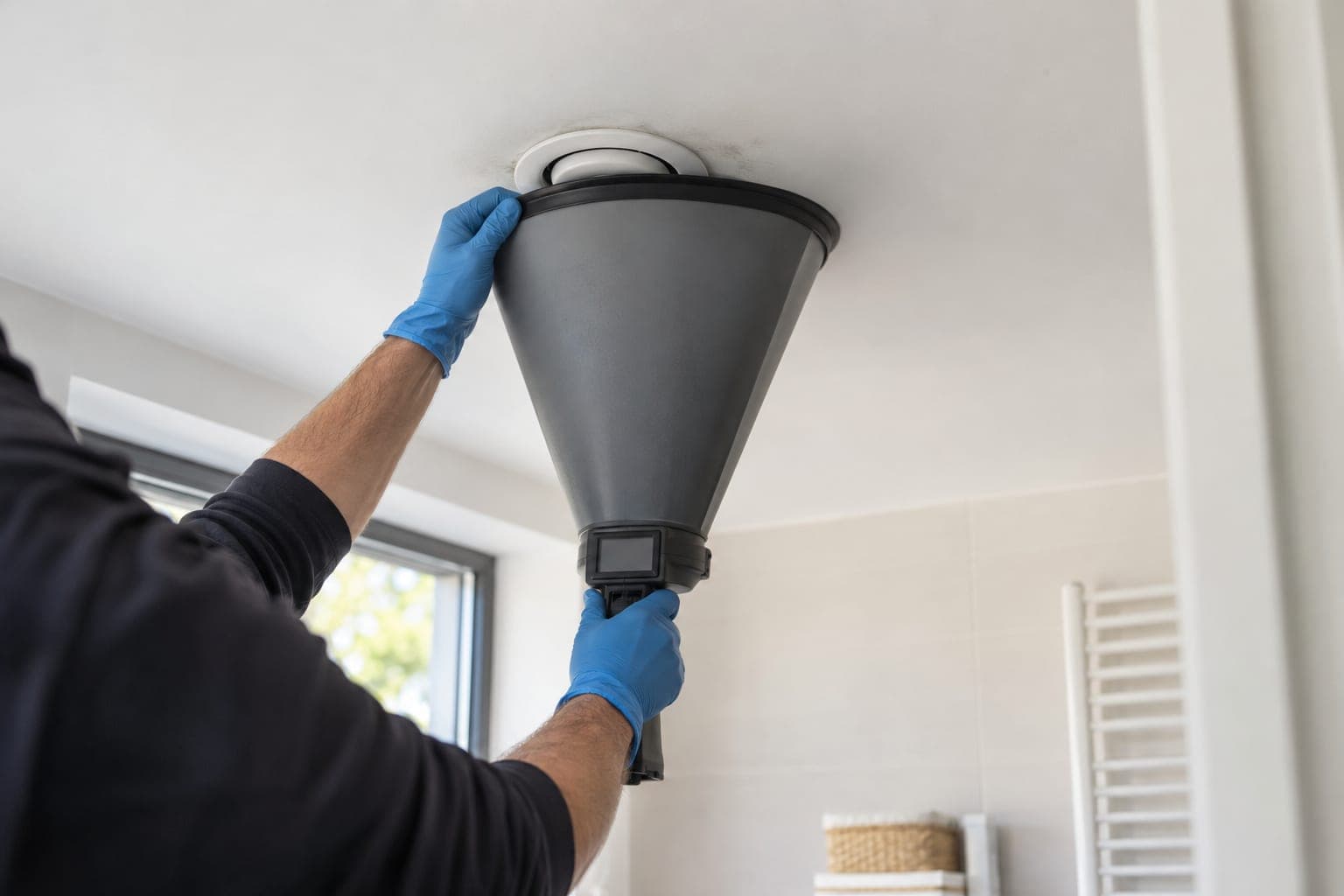
Many expensive decisions are taken without any measurement: a unit is replaced, ducts are cleaned, a dehumidifier is bought, without anyone checking what the system actually extracts. An airflow survey costs a fraction of that work and points the spending in the right direction.
We take room-by-room readings with a flow meter, compare them with the design values in NBN D50-001, and log CO₂ and relative humidity over several days to see how the home behaves in use, not just at the moment of the visit.
This assessment is particularly useful before buying a property, with persistent damp, in a dispute with a contractor, or when tenant and landlord disagree about the cause of a problem.
Indicative measurement and EPB sign-off
What this service costs
One price per system, published before you book, with no questionnaire to fill in to get it. Anything out of the ordinary (a lot of valves, an unreachable unit, a system never opened) we tell you before the visit, never on the invoice.
Prices exclude VAT. 6 % on servicing in a private home over ten years old, 21 % otherwise.
What the service covers
Airflow measurement
Flow meter readings at every extract and supply valve, at all available speeds, with the measurement conditions recorded.
Comparison with design values
Required flow rates calculated per room to NBN D50-001 from measured floor areas, with the shortfall quantified.
CO₂ and humidity logging
Data loggers left for several days in the critical rooms (bedrooms, living room, bathroom). The curves show real peaks, including overnight.
Weak-point survey
Missing or blocked transfer grilles, crushed ducts, sealed-off valves, an air intake facing a discharge. These faults often account for the entire shortfall.
Spot thermographic survey
On request: identification of thermal bridges and cold surfaces where condensation preferentially forms.
Written report and recommendations
A quantified, room-by-room document with actions ranked by cost against effect. You can hand it to any contractor.
How the visit works
- 1
Site survey
Floor areas, system type, room layout and air transfer paths.
- 2
Measurement campaign
Airflow measured on the day, CO₂ and humidity loggers left in place for a few days.
- 3
Collection and analysis
Curves processed and cross-referenced with measured airflow and the layout recorded.
- 4
Report handover
Results presented, discrepancies explained and priorities set out.
Frequently asked questions
What airflow should my ventilation achieve?
NBN D50-001 derives flow rates from room floor areas, with minimum and maximum values by room type. Our online calculator gives you the order of magnitude in seconds; on-site measurement tells you where you actually stand.
Is CO₂ really a good indicator?
It is the best simple indicator of air renewal when people are present, because it tracks their breathing directly. It says nothing about chemical pollutants or particulates, but CO₂ climbing steeply overnight in a bedroom reliably signals insufficient air renewal.
How long do the loggers stay in place?
A few days is usually enough to cover a representative usage cycle, weekend included. They are discreet, silent and need nothing from you.
Is the report usable against a contractor?
Yes: it contains measured values, the method used and the standard referenced. It is a technical document, not a sales pitch, and we have no interest in inflating the shortfall, since we invoice the assessment and not the work that follows from it.
Related services
- Ventilation maintenanceA serviced ventilation system uses less energy, runs quieter and actually removes the moisture from your home.
- Duct cleaningCleaning the valves achieves nothing if the ductwork behind them is fouled. We treat the duct along its full length.
- Ventilation repairDiagnosis first, repair second. We only replace a unit when that is genuinely the right call.
A question about this service?
Describe your system: we tell you whether this service is the right answer to your situation, or whether something else is needed.