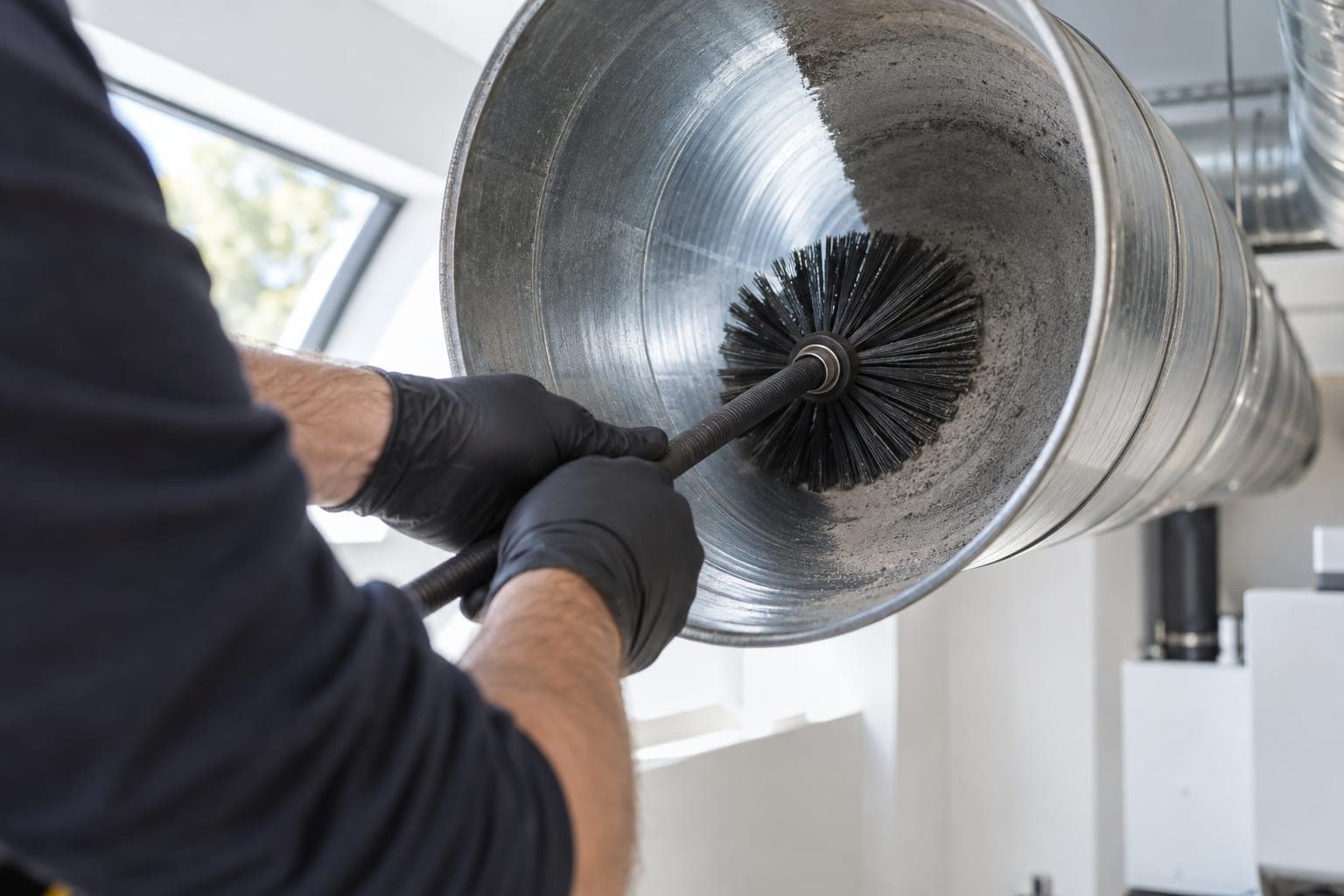
Dust, cooking grease and outdoor particles settle slowly on duct walls. After a few years the deposit reduces the usable cross-section, increases system resistance and becomes a substrate for mould growth in damp areas.
Duct cleaning is mechanical work: you do not spray a product into a valve and hope it travels. We drive rotary brushes through the network while extracting at the other end, then verify the result with a camera.
It is particularly worthwhile after building works, when taking over a property, in commercial kitchens, and in buildings where the ducts have not been opened since construction.
What cleaning does not fix
What this service costs
One price per system, published before you book, with no questionnaire to fill in to get it. Anything out of the ordinary (a lot of valves, an unreachable unit, a system never opened) we tell you before the visit, never on the invoice.
Duct cleaning, extract-only system
System C: extract network brushed under negative pressure, from every valve to the unit.
Price on quote, confirmed before the appointment.
From€199
Duct cleaning, heat-recovery system
System D: both networks, extract and supply, brushed under negative pressure.
Price on quote, confirmed before the appointment.
From€299
Service + duct cleaning pack, extract-only
Full service and duct cleaning in a single visit, cheaper than the two booked separately.
Price on quote, confirmed before the appointment.
From€299
Service + duct cleaning pack, heat-recovery
Full heat-recovery service and cleaning of both networks in a single visit.
Price on quote, confirmed before the appointment.
From€429
Prices exclude VAT. 6 % on servicing in a private home over ten years old, 21 % otherwise.
What the service covers
Camera inspection beforehand
An endoscopic camera travels the network. You see the real condition of your ducts before we start, and decide on that basis.
Rotary mechanical brushing
Brushes matched to the diameter and material (rigid, flexible or semi-rigid duct). The deposit is released mechanically, not chemically.
HEPA-filtered extraction
The network is held under negative pressure throughout the brushing: released particles end up in the vacuum, not in your rooms.
Targeted disinfection
Only where it is justified (signs of fungal growth, bathrooms, kitchens), with a product suitable for air handling systems and controlled ventilation afterwards.
Access hatch installation
Where the network has none, we fit standard hatches at strategic points. Future cleaning is then faster and cheaper.
Before / after photo report
Inspection images at the same points, before and after. It is the only honest way to judge the result.
How the visit works
- 1
Inspection and quote
Network survey, camera inspection, estimate of duct length and access points. The quote is built on that, with no later surprises.
- 2
Protecting the premises
Sheeting, floor and furniture protection, sealing of untreated valves to maintain negative pressure.
- 3
Cleaning
Section-by-section brushing with simultaneous extraction, working from the valves towards the main trunk.
- 4
Unit servicing
The casing, impellers and heat exchanger are cleaned at the same time: cleaning ducts without cleaning the unit makes no sense.
- 5
Final check
Fresh camera inspection at the same points, then photo report handover.
Frequently asked questions
How often should ducts be cleaned?
There is no regulatory interval for a home in Belgium. In practice, camera inspection is the right criterion: it shows whether there is a deposit worth treating. A normal home does not need annual cleaning; a commercial kitchen does, and often more frequently.
How much does ventilation duct cleaning cost?
One price per system, extract-only or heat-recovery, shown on this page and on the pricing page, known before you book. It covers camera inspection, brushing of the whole network, cleaning of valves and casing, and before/after photos. The service + cleaning pack combines the full service and the duct cleaning in a single visit, cheaper than the two booked separately.
My ducts are flexible aluminium. Can they be cleaned?
Yes, with a soft brush at low speed or by hand on short runs, never with a stiff brush that would tear the pleats. The camera inspection decides beforehand. A section that is already split or too heavily fouled is not brushed: where it is reachable, replacing it takes ten minutes and a few euros of duct, and we offer that rather than forcing it.
Does cleaning solve smell problems?
Often, but not always. A smell can also come from a dried-out trap, an air-tightness fault between dwellings, or a badly positioned air intake. Inspection tells them apart before you commit to costs.
Do I have to leave during the work?
No. Extraction keeps the network under negative pressure and particles stay inside the circuit. Where disinfection is used, we ventilate the rooms concerned and tell you how long to wait before normal use.
Do you work in apartment buildings?
Yes. We provide the managing agent with a technical description, a schedule per riser and a photo report per apartment, which makes presenting the work at the owners' meeting easier.
Related services
- Ventilation maintenanceA serviced ventilation system uses less energy, runs quieter and actually removes the moisture from your home.
- Smells and ventilationA smell that arrives through the ventilation always has a path. We find it, we close it, and we tell you when the problem is not in your home.
- Measurement and air qualityMeasure before you spend. A written report tells you whether your ventilation is doing its job, and by how much it falls short.
- Ventilation repairDiagnosis first, repair second. We only replace a unit when that is genuinely the right call.
A question about this service?
Describe your system: we tell you whether this service is the right answer to your situation, or whether something else is needed.