Ventilation motor that is noisy, running hot or no longer turning: repair or replace?
A ventilation motor rarely dies all at once. It gives warning: a hum that turns into a rumble, a speed that stops responding, a hot smell. We come and listen before it stops, and we only replace what has to be replaced.
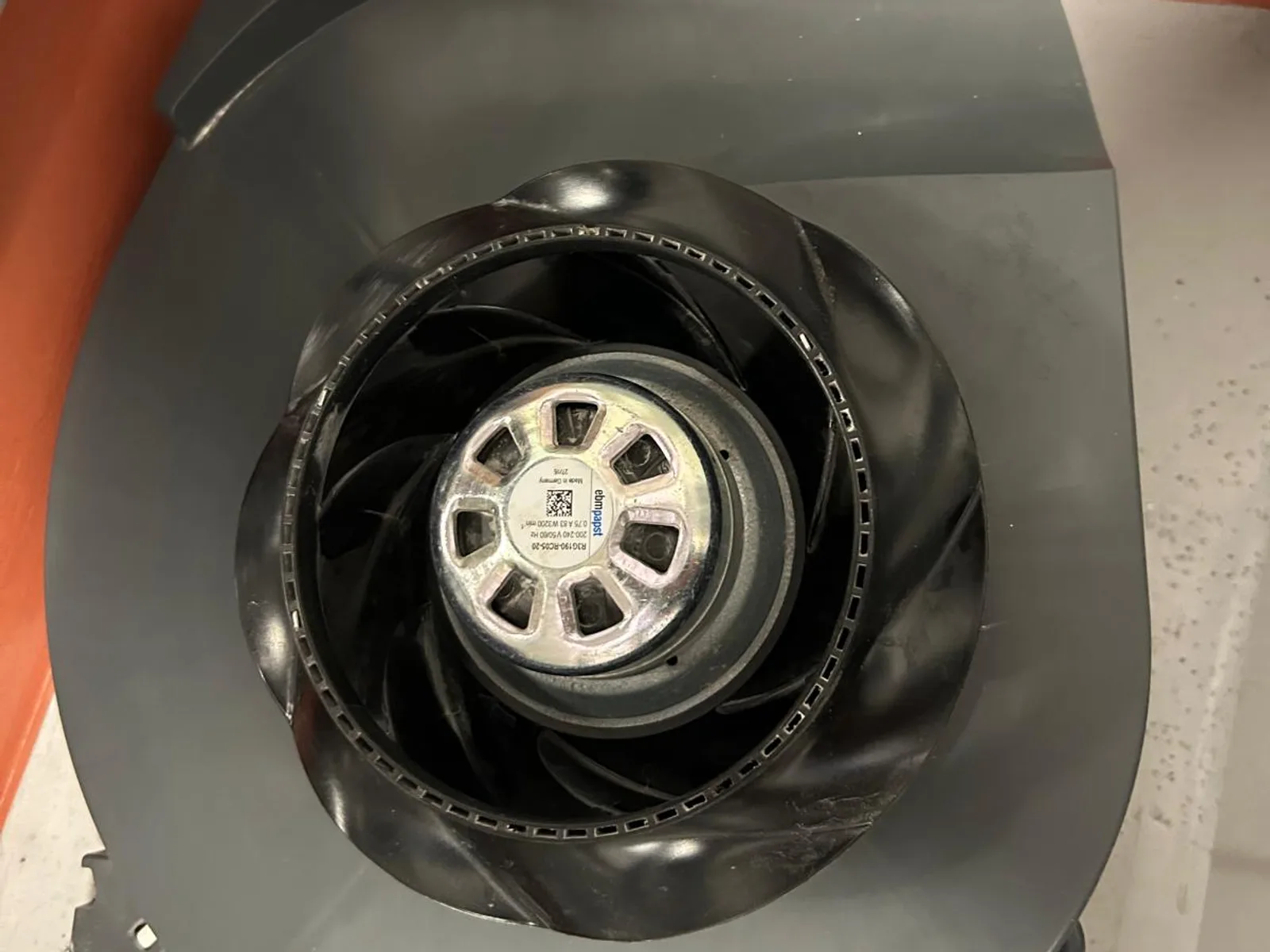
Before / after
What a service changes, in pictures
Photos taken by our technicians on recent jobs, unedited.
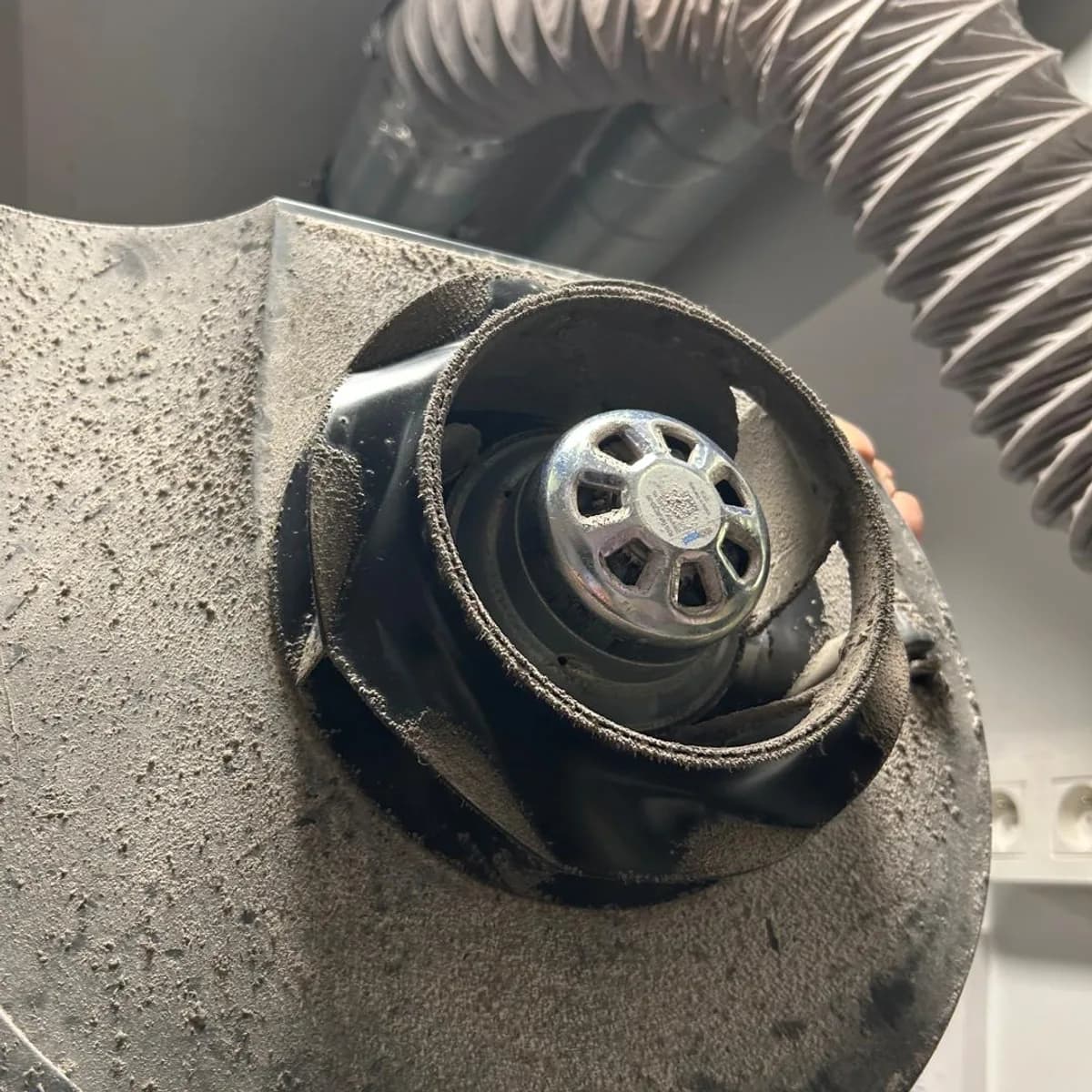 Before
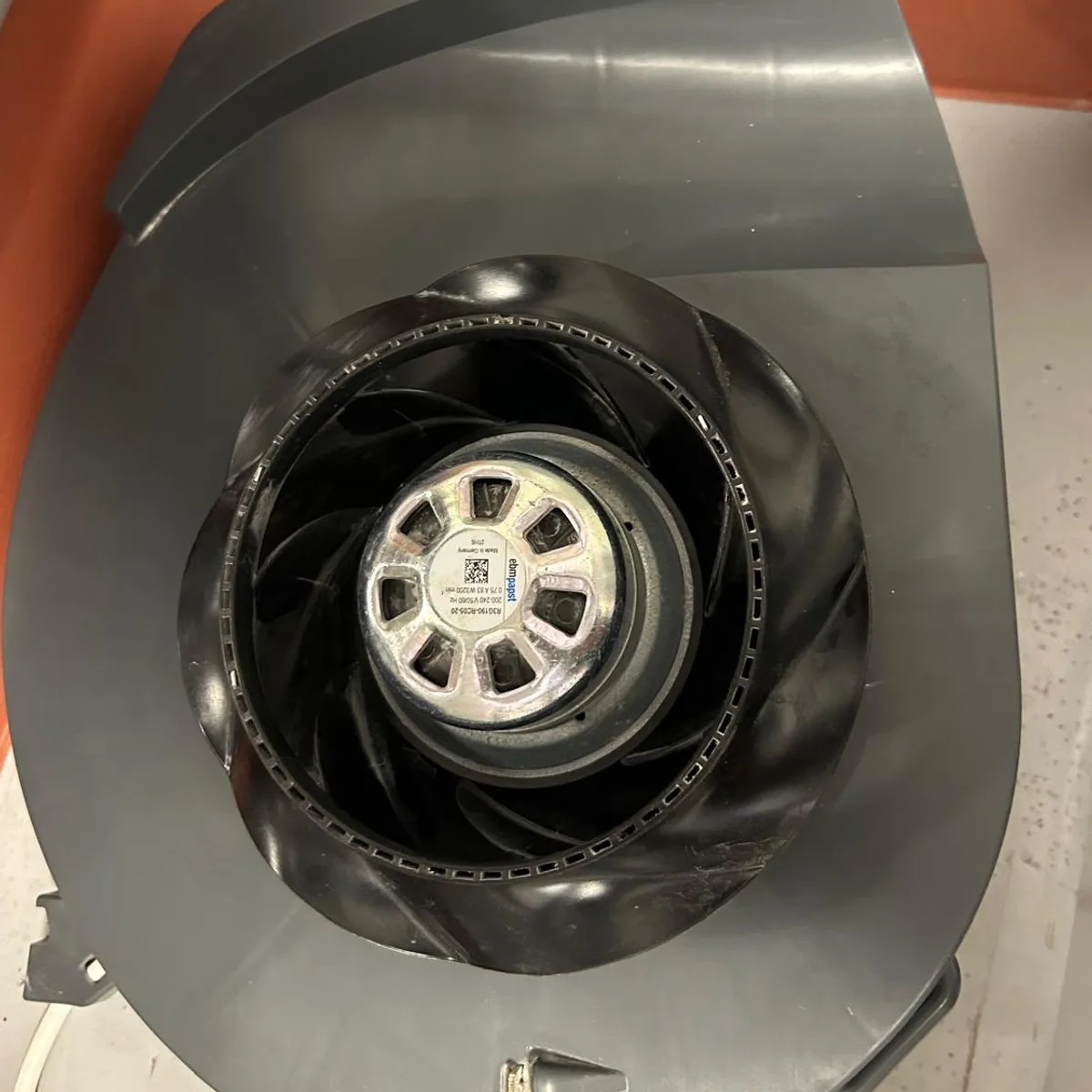 After
Impeller and motor of a heat-recovery unit
You hear it from the bedroom at night, when everything else is quiet. Or the opposite: no draught at the vents any more, a bathroom that stays steamed up, windows beaded with water in the morning. Either way, the first suspect is the motor in the unit, and it is the most common failure on a system more than ten years old.
What we find most often, in order: a dirty impeller that has gone out of balance and shakes the whole casing, bearings with play in them, a tired start capacitor that makes the motor stall on start-up, a control board that only drives one speed any more, and finally the motor itself, with a burnt winding or a seized shaft. Only that last cause calls for a new motor.
We work on extract-only (system C) and heat-recovery (system D) units of every brand found in Belgium: Zehnder, Renson, Aldes, Brink, Vasco, Orcon, Lemmens, Atlantic, Unelvent and others. When the manufacturer still supplies the part, we order it; when it no longer does, we tell you what equivalent exists, or whether it makes more sense to replace the unit.
Repair the motor or replace the unit?
What this service costs
One price per system, published before you book, with no questionnaire to fill in to get it. Anything out of the ordinary (a lot of valves, an unreachable unit, a system never opened) we tell you before the visit, never on the invoice.
Breakdown, call-out and diagnosis
Noise, stoppage, lost airflow. One hour on site to find the cause.
€120
Heat-recovery ventilation service
System D: filtered fresh air to living spaces, with heat recovery.
Autumn holiday offer Until 8 November. During the school holidays you are home more often: the right time for a service, before winter.
€159
Extract ventilation service
System C: mechanical extract from wet rooms, façade vents for supply.
€139
Prices exclude VAT. 6 % on servicing in a private home over ten years old, 21 % otherwise.
What the service covers
Listening to and measuring the motor
Noise at each speed, casing vibration, current drawn, temperature after ten minutes of running. A healthy motor and one at the end of its life do not sound or measure the same: the reading decides where the ear hesitates.
Impeller removed and cleaned
An impeller caked in greasy dust runs out of true and wears the bearings. Removed, brushed and balanced, it often makes a motor quiet again without replacing anything. It is the most common repair, and the cheapest.
Bearings and capacitor
On motors that allow it, the bearings can be replaced. A start capacitor takes minutes to change and fixes motors that hum without starting or need a push to get going.
Motor replacement
When the winding is burnt or the shaft seized, the motor is replaced with the original part or its equivalent, wired in and set to the original speeds. The price of the part and the fitting is given to you before the order, never after.
Control board and speeds
A motor that no longer responds to the wall control, stays stuck on low speed or no longer changes speed is not necessarily dead: the board, relay and sensor are checked before we conclude.
Check after repair
Noise, vibration, current and airflow at the vents after reassembly. You get a written record of what was done and what we measured.
How the visit works
- 1
Describe the symptom
Noise, stoppage, stuck speed, hot smell; since when; system C or D; brand if you know it. A ten-second video of the noise, sent by email, already tells us a lot.
- 2
On-site diagnosis
One hour, call-out and diagnosis, €120 excl. VAT. We open the unit, remove the impeller, listen to and measure the motor at each speed, check the board and the capacitor.
- 3
Repair within the hour where possible
Impeller cleaned and rebalanced, capacitor replaced, connection tightened, anti-vibration mounts redone: whatever can be done on site is done on site, with the price given first.
- 4
Quote if the motor has to be replaced
Exact reference read off the motor itself, original or equivalent part, price of part and fitting in writing. You decide, then we order. Lead time depends on availability at the manufacturer; we tell you before ordering.
- 5
Fitting, setting and check
Motor fitted, speeds set as originally, airflow and noise checked at the vents. The written record notes the reference fitted, useful for the rest of the unit's life.
The noise: bearings, impeller, or simply dust
Noise is the symptom people call about, and also the most misleading. A dull rumble that rises with the speed often comes from the bearings. A hum that vibrates in the wall comes from an impeller thrown out of balance by dust, or from a crushed rubber mount. A sharp click at every start comes from a tired capacitor. Three noises, three repairs, and only one of the three needs a motor.
That is why we never replace a motor on a phone description. One hour on site, impeller removed, motor listened to unloaded and under load: the cause is identified, and the quote that follows contains only what is necessary.
- Bearings: continuous noise that grows with speed and temperature.
- Dirty impeller: vibration passed to the casing and the wall, noise that varies with the dirt.
- Capacitor: humming at start-up, motor that needs a push or several tries.
- Mounting: crushed rubber mounts, casing in direct contact with the structure.
Heat-recovery unit motor: two fans, and parts that can be found
A heat-recovery unit has two motors, one for fresh air and one for extract air, most often electronically commutated DC motors, quiet and economical but sensitive to damp and dust when the filters are not changed. When one of the two weakens, the unit goes out of balance: stale air leaves faster than fresh air comes in, or the reverse, and the house goes into negative or positive pressure.
On Zehnder, Renson, Brink, Vasco, Aldes or Orcon, motors can still be found for most models of the last fifteen years. We read the exact reference off the motor itself, not the unit's rating plate: the same model has often been through several generations of fans.
- Both motors measured: only one replaced if only one is at fault.
- Speeds and airflow balance set after fitting.
- Heat exchanger and filters checked in the same visit.
Extract-only unit motor: often cheaper to replace than to repair
An extract-only unit has a single motor, often a small AC motor with a capacitor, in a casing in the loft or a false ceiling. These motors are inexpensive and quick to replace; when the bearings are gone, repair makes no sense against the price of a new one. What we check first are the capacitor and the dirt on the impeller, which explain half of all stoppages.
Recent humidity-controlled units have a board that modulates speed according to humidity: a motor that seems broken is sometimes simply obeying a dirty sensor. There too, measuring avoids a needless part.
What it costs, and what we cannot tell you over the phone
On-site diagnosis is €120 excl. VAT, call-out and an hour's work included, with a written record. What you pay afterwards depends on the cause: an impeller clean or a capacitor is often settled within that hour, with the price given first; a new motor gets a quote, part and fitting, because its price varies threefold depending on brand and model.
So we do not give motor prices over the phone, and we are wary of those who do: it means they will replace the motor whatever happens. You get a figure once we know which one, and you stay in control.
The brands we service
These are the brands actually found in Belgian homes, from a 1998 unit hidden above a suspended ceiling to a heat-recovery system fitted last year. We are not a dealer for any of them, so we have no reason to steer you towards one over another. We service whatever is already in your home.
The brand is not a prerequisite
- Renson
- Duco
- Zehnder
- Brink
- Vasco
- Lemmens
- Aldes
- Atlantic
- Helios
- Itho Daalderop
- Orcon
- Ubbink
- Buva
- Soler & Palau
- Wolf
- Codumé
Frequently asked questions
My ventilation makes a bearing noise. Does the motor need replacing?
Not necessarily. On a good share of motors the bearings can be replaced, and on many units the noise actually comes from an impeller thrown out of balance by dust or a crushed mount, which are fixed without a new motor. The on-site diagnosis tells you within the hour. If the motor really is at the end of its life, we give you the price of the part and the fitting, and you decide.
How much does a ventilation motor cost?
The price varies a lot by brand and model, and we only know it after reading the exact reference on the motor. What is fixed: the on-site diagnosis, €120 excl. VAT, call-out and written record included. The motor, if it has to be replaced, is quoted in writing before any order.
The manufacturer no longer supplies the part. What do you do?
We look for an equivalent motor, same dimensions, same power, same mounting, from the motor makers who supply the manufacturers. When none exists, we tell you and quote for replacing the unit, rather than fitting an approximate part that will vibrate.
The unit smells hot. Is that dangerous?
A hot or plastic smell near the unit points to a motor that is straining, seized bearings or a winding heating up. Motors have a thermal cut-out that trips before anything happens, but that is no reason to wait: switch the unit off at the breaker and call. A motor that has been running hot for weeks ends up taking the board down with it.
Can I change the motor myself?
On an extract-only unit in the loft, a DIYer comfortable with 230 V can. But the motor is not always the cause, the reference is hard to read, and a badly set new motor makes for a noisy unit. We recommend at least the diagnosis: you will know which part to order, and whether it really is that one.
Is it better to repair or to replace the whole unit?
A new motor in a unit under twelve years old is almost always the right spend. Beyond fifteen years, or when the heat exchanger, casing and board show their age, we give you both figures and our opinion. A recent unit uses less power and finds parts for longer.
Related services
- Ventilation repairDiagnosis first, repair second. We only replace a unit when that is genuinely the right call.
- Ventilation maintenanceA serviced ventilation system uses less energy, runs quieter and actually removes the moisture from your home.
- Smells and ventilationA smell that arrives through the ventilation always has a path. We find it, we close it, and we tell you when the problem is not in your home.
- Ventilation installationA good installation is decided before anything is fitted: duct routing, sizing, unit location. The rest is assembly.
A question about this service?
Describe your system: we tell you whether this service is the right answer to your situation, or whether something else is needed.